Self-rated vs real data: how the OVR is actually built
Giving a young player an OVR rating is a great idea. Everything depends on where the number comes from — one asks your player to score themselves, the other reads their real games. That's the whole difference here.
Built on 1205 real games and 12,716 player records across 7 leagues — never a self-score.
Forward · RHA Kelowna · U18 Prep CSSHL
Sample player card — anonymized data from the live app.
The core difference: who decides the number
Self-rating apps popularized the “your player has an OVR” concept, and it's a genuinely fun, motivating idea. The catch is the input: the rating is entered — by the player or parent, often off a single clip or a gut feeling. Whatever opinion goes in is the opinion that comes out.
Shift Excellence builds the OVR the other way around: from your player's real games. Box scores, advanced game data where available, ranked on a percentile basis against their actual division. The number isn't something you set — it's something the games reveal, and it's scaled by data strength so it doesn't overstate what the data can't back up yet.
Why this matters for a parent
A self-scored rating can't tell you anything new — it can only confirm what you typed in. A data-built rating can tell you your defenseman's hockey IQ is quietly elite, or that the points are hiding a possession problem. That's the entire value of measuring: being able to be surprised, and to act on it.
Side by side
A fair read: self-rating is a fun motivator; real data is what tracks development.
| Shift Excellence | Self-rated OVR apps | |
|---|---|---|
| Where the rating comes from | Real game data | Self-assessment |
| Uses box scores | ||
| Uses advanced game data | ||
| Ranked vs real division | ||
| Game report on each game | ||
| Updates every game | Only if re-entered | |
| Data-strength scaled | ||
| Can surprise you | ||
| Price | From $19.99/mo, or $4.99 pucks | Varies (often free) |
See the difference
A number the games earned — and can benchmark
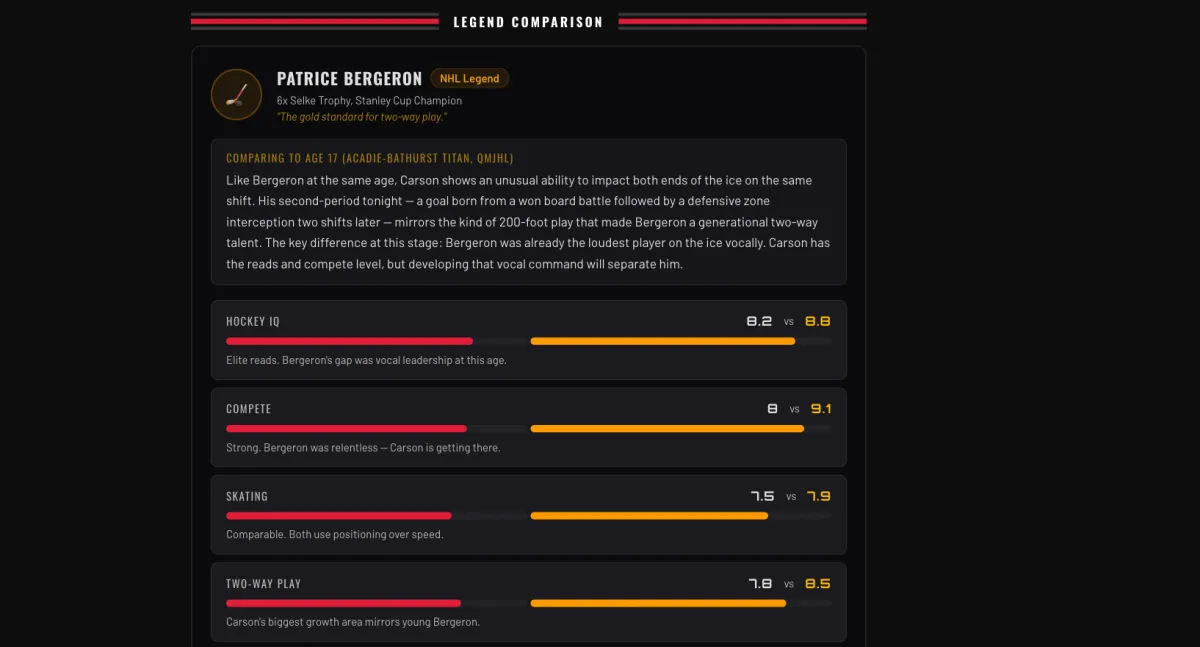
Because the rating comes off the ice, it can rank your player against their real division and even measure them against an NHL comp. A self-score can't do that.
A rating you can trust the process behind
“Trust the process” usually means ice time, games, and reps — all inputs, with no way to see if it's working. A self-rated OVR doesn't fix that; it just puts a number on the same hunch. A rating built from real games gives the process a scoreboard: you can watch it move as the work goes in, and know it moved because the games moved it — not because someone bumped a slider.
A self-score is an opinion with a number on it. The process is the work that earns the number. We don't replace your coach — we give the development they're working toward a scoreboard.
Frequently Asked Questions
Why trust the number
Built by hockey people. Backed by real data.
Pro-level evaluation
Designed with coaches who've worked in pro and elite youth hockey — your player is graded the way scouts actually evaluate talent, not by a self-rating.
Real games, not opinions
Real game data tracked for 12,716 players across 7 leagues and 478 teams. Every rating comes from real game data, measured against your player's own division.
The number is earned
Nobody scores themselves. The OVR comes off the ice and it moves as the work goes in — so progress is something you can see, not argue about.
“Every parent asks the same thing — is my child actually developing? For the first time there's a real answer on the ice, not a hunch. This is how pro organizations evaluate players, built for youth hockey.”
Get an OVR your player actually earned
Built from real games — see it find its level.