What's an OVR rating in hockey? How we grade youth players
One number from 1–100, across six skills — built from your player's real games, not a self-assessment. It updates after every game so you can watch development happen.
Forward · RHA Kelowna · U18 Prep CSSHL
Sample player card — the OVR and six skill scores, anonymized from the live app.
Your player has an OVR
If you've ever played EA NHL, you already understand an OVR. Every player carries one number — an “overall” from 1 to 100 — that sums up how good they are. A 92 is an elite player; a 68 is a solid contributor still rounding out their game.
An OVR rating in Shift Excellence works the same way, with one crucial difference: the number isn't a developer's guess. It's built from your player's real games. It's a single, honest snapshot of where they stand — and, more importantly, a number you can watch move as they develop.
Under the number
The six categories
Skating
Speed, edges, and how a player moves to space — drawn from pace and zone-transition data.
Shooting
Volume, accuracy, and dangerous-area shots — not just goals, but how a player generates them.
Hands
Puck control, passing, and the skill plays that drive offense.
Checking
Physical engagement, body positioning, and puck battles won.
Defense
Defensive responsibility, takeaways, and play without the puck.
Hockey IQ
Reading the game: smart passing, staying disciplined, and puck possession.
Real data, not a self-assessment
This is the part that matters. A lot of “rating” apps ask a player to score their own skating off one clip. The number that comes out the other end is just the opinion that went in.
Our OVR is scaled by data strength from real box scores and advanced game data — not a self-assessment. It reads what actually happened on the ice, ranks it against the division, and only firms up as more real games back it up. The number means something because it was earned, not entered.
How the math works
The OVR is percentile-based. A 72 means your player grades out better than roughly 72% of players in their division — not an abstract score, but a real ranking against real peers.
It's also position-weighted and adjusted by player identity. A defenseman isn't penalized for scoring fewer goals than a winger; a playmaker isn't graded like a power forward. The model knows what a strong version of each role looks like and scores against that.
Real benchmarks
What's a good OVR?
| Group | Median OVR (est.) | Top 10% (est.) | Standout (est.) |
|---|---|---|---|
| All U18 skaters | 53 | 59+ | 80 |
| Forwards | 55 | 60+ | 80 |
| Defense | 50 | 57+ | 61 |
Based on 303 rated CSSHL U18 Prep skaters. A typical U18 Prep skater sits in the low 50s; the top 10% are 59 and up. We don't yet have enough U15 or U13 players to publish a fair benchmark for those ages — and we won't make numbers up. Those tables expand as more players join.
The OVR gets more accurate with data
A new player with only a few games. The rating stays near the floor because we won’t overstate what we can’t back up yet.
A full season of box-score stats. Data strength rises and the number settles into a realistic, established rating.
Advanced game data plus a completed Game Report. The most precise picture — our one fully verified player sits at 69.
The OVR doesn't just go up — it gets more accurate. For most players that means rising off a conservative floor as real data arrives, but it can also correct downward. Defense and hockey IQ climb most once you add a Game Report, because box scores under-measure them.
Player identities, with NHL comps
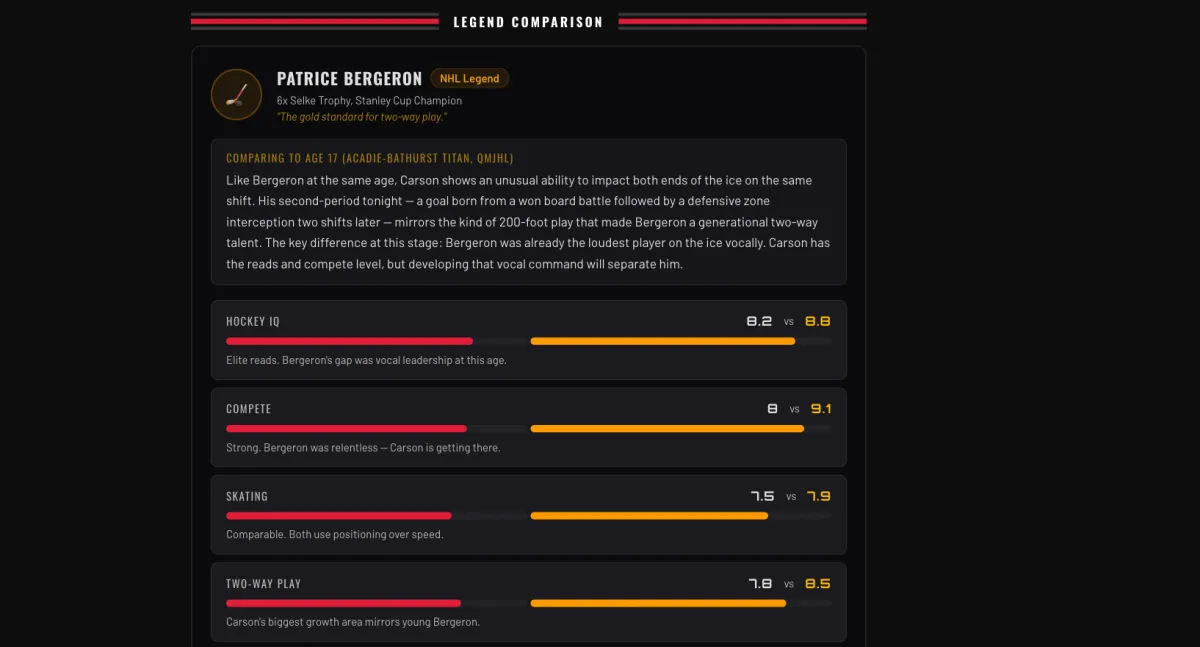
Two players can share an OVR and play completely different games. That's why every player is also mapped to a player identity — Sniper, Playmaker, Two-Way Forward, Power Forward, Offensive Defenseman, Shutdown Defenseman, and more — each with an NHL comp so the style is easy to picture.
What moves the number
The fastest way to move an OVR is to add data the box score misses. A defenseman who logs puck battles through advanced game data will see Defense and Hockey IQ, the two categories that start lowest, climb once those plays are counted.
Beyond that, it's the real stuff: more dangerous shots lifts Shooting, winning more battles lifts Checking, cleaner zone entries lift Skating, and puck-possession data lifts Hockey IQ. The number rewards the same things a good coach does.
Frequently Asked Questions
Why trust the number
Built by hockey people. Backed by real data.
Pro-level evaluation
Designed with coaches who've worked in pro and elite youth hockey — your player is graded the way scouts actually evaluate talent, not by a self-rating.
Real games, not opinions
Real game data tracked for 12,716 players across 7 leagues and 478 teams. Every rating comes from real game data, measured against your player's own division.
The number is earned
Nobody scores themselves. The OVR comes off the ice and it moves as the work goes in — so progress is something you can see, not argue about.
“Every parent asks the same thing — is my child actually developing? For the first time there's a real answer on the ice, not a hunch. This is how pro organizations evaluate players, built for youth hockey.”
See your player's OVR
Bring in one game and watch the number find its level.