CSSHL recruitment: how players advance to the next level
The junior, NCAA, and U Sports pathways out of the CSSHL — what scouts actually look for, and how to show the one thing a highlight reel can't: a development arc.
The CSSHL exists to move players to what comes next — junior hockey (the WHL, BCHL, and other Junior A leagues), NCAA and U Sports college hockey, and the pro paths beyond. It's a genuinely scouted league. But parents consistently misread what actually gets a player noticed, and it costs them looks. (New to the league? Start with the CSSHL parent guide.)
Why the CSSHL gets scouted
Academy programs play a long, structured season against other elite teams, so a full body of work builds up over the year. Junior, NCAA, and U Sports staff know that — they watch the league, attend showcases, and pull game data. That's the opportunity. The catch is simple: a scout who sees one game sees one game. What earns a real, sustained look is a pattern.
What scouts really look for
Points get you on a list. They don't keep you there. Scouts evaluate skating, hockey sense, compete level, and — above all — trajectory. A player who is clearly better in February than in October is far more interesting than one who started hot and flatlined. They're betting on the next two years, not the last two weekends.
The pathways out of the CSSHL
- Major junior (WHL): drafted and developed toward pro hockey on a fast, demanding timeline.
- Junior A (BCHL and others): a common route that protects NCAA eligibility while a player matures — the middle path most parents should understand. See our guide to junior hockey.
- NCAA / U Sports: college hockey, where academics and a documented development record both carry weight — often alongside a scholarship conversation.
Each path has a different timeline and different gatekeepers. The common thread: every one of them rewards evidence that a player is still climbing.
The gap most parents miss
Show the arc, not just the highlight
A reel shows a player's best three shifts of the season. It can't show whether they're getting better — which is the exact thing scouts are trying to read.
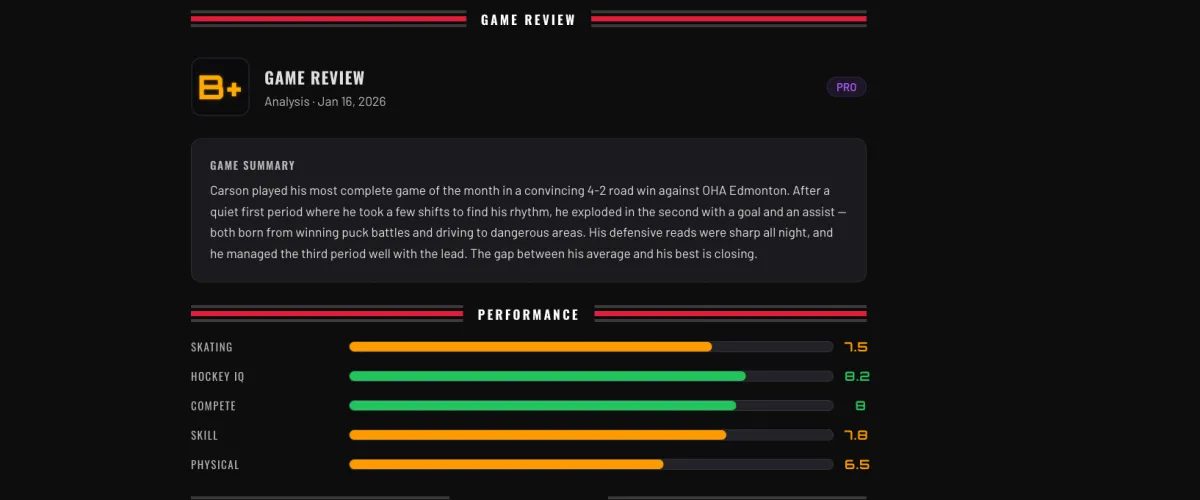
Most players have highlights. Almost none have proof of development. A consistent, game-by-game record can show it — and that record is precisely the trajectory a scout is trying to project forward.
Shift Excellence builds that record automatically. Every game becomes a coach-style Game Report, and the six-skill OVR rating updates each time — so the climb is visible instead of anecdotal, and progress over a season is something you can point to.
Points get you on the list. The arc keeps you on it.
For context, our real CSSHL U18 Prep benchmark sits at a median OVR of 53, with the top 10% at 59 and up — so a player can see where they actually stand against their own division, not just where they feel they stand. That's the difference between a hunch and a case.
Keep going
The recruitment playbook
How to Get Scouted
The broader playbook on getting noticed — showcases, exposure, and what actually moves the needle.
How to Get Recruited
From first looks to commitments: the recruitment timeline and how parents should work it.
Junior Hockey Explained
WHL vs. BCHL vs. Junior A — the routes out of the CSSHL and what each one costs you.
CSSHL Parent Guide
How the league works, what the divisions mean, and how to read your player's development.
Why trust the number
Built by hockey people. Backed by real data.
Pro-level evaluation
Designed with coaches who've worked in pro and elite youth hockey — your player is graded the way scouts actually evaluate talent, not by a self-rating.
Real games, not opinions
Real game data tracked for 12,716 players across 7 leagues and 478 teams. Every rating comes from real game data, measured against your player's own division.
The number is earned
Nobody scores themselves. The OVR comes off the ice and it moves as the work goes in — so progress is something you can see, not argue about.
“Every parent asks the same thing — is my child actually developing? For the first time there's a real answer on the ice, not a hunch. This is how pro organizations evaluate players, built for youth hockey.”
Frequently Asked Questions
Build your player's development record
Turn every CSSHL game into a report and an OVR that shows the climb — the trajectory scouts are actually looking for.